
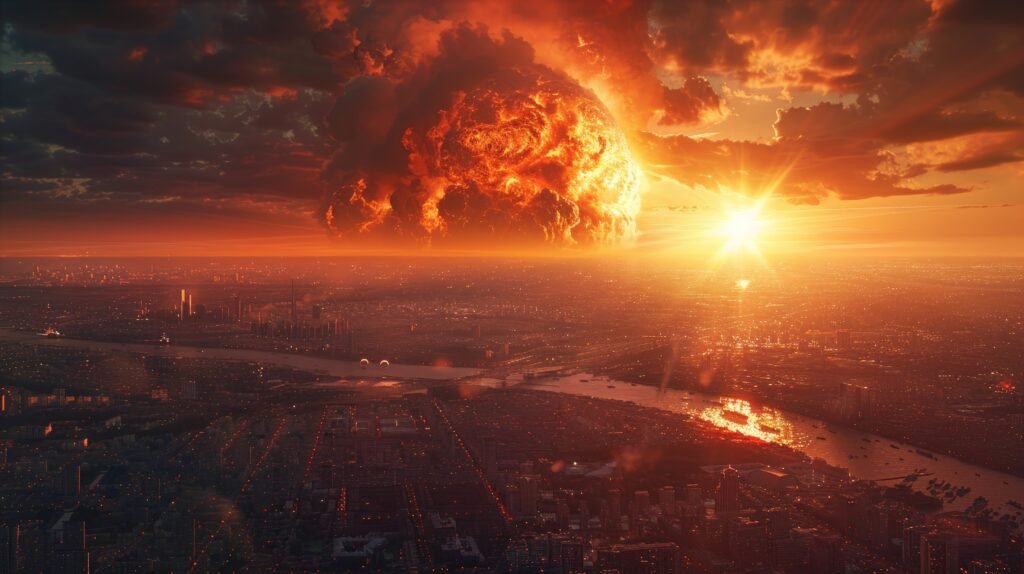
The question has a way of stopping you mid-scroll. You see a headline about Iran, or a drone entering Polish airspace, or China surrounding Taiwan with warships, and something in the back of your mind starts asking it. Are we actually heading toward World War 3? Not in the abstract, distant, something-that-happens-to-other-generations way. Right now. In 2026.
It is a question that used to belong to Cold War documentaries and late-night conspiracy forums. Today it is being asked by heads of state, decorated military analysts, and billionaire investors who spend their careers reading the long-term patterns of history. That shift alone is worth paying attention to. When the people whose job is to stay calm start using the words, something has changed.
This article is an honest attempt to answer the question properly. Not to alarm you, not to dismiss you, but to walk through what is actually happening right now in world war 3 news 2026, what history tells us about how these things unfold, and what the realistic picture looks like when you set aside both the panic and the wishful thinking.
What Would World War 3 Actually Require?
Before you can assess how close we are to something, you have to understand what that something actually is. A third world war would not just be a big war. Historians broadly agree it would need to pull in most of the principal nations of the world, the kind of conflict where the great powers are not supporting others from the sidelines but are directly fighting each other.
World War One started with the assassination of a single archduke in Sarajevo. That one event set off a chain of alliance obligations, mutual defence treaties, and imperial rivalries that no government fully understood until it was too late to stop. Austria-Hungary moved against Serbia. Russia mobilized to defend Serbia. Germany declared war on Russia. France was treaty-bound to back Russia. Britain entered when Germany marched through Belgium. Within six weeks, most of Europe was at war. Twenty million people died. Nobody planned it that way. Nobody wanted it to go that far. It went that far anyway because the system of interlocking commitments meant that each decision to escalate automatically triggered the next one.
World War Two followed a similar pattern in a different key. Years of unchecked territorial aggression, failed appeasement, and the slow collapse of the international institutions designed to prevent exactly this kind of thing eventually produced the largest and most destructive conflict in human history. The lesson both wars carry is the same one. World wars do not begin with a clean declaration of intent. They begin with escalation that spins beyond anyone’s ability to contain.
That is the part that makes the current world war 3 2026 conversation feel different from the usual background noise of geopolitical tension. It is not any single conflict on its own. It is the number of them happening simultaneously, the actors involved, and the way they are beginning to connect to each other.
The World in April 2026
Trying to describe the current global situation in a single paragraph is almost impossible because so much is happening at once. That in itself is part of what makes analysts nervous. Usually there is one dominant crisis that absorbs diplomatic attention and resources. Right now there are several.
The war in Ukraine is entering its fifth year. Russia launched its full-scale invasion in February 2022 and the conflict has ground on ever since through eastern Ukraine, producing staggering casualties on both sides and turning entire cities into rubble. February 2026 was actually the first month since 2024 in which Ukraine reclaimed more territory than it lost, which represents a real shift on the battlefield. But the war is nowhere near over. Russian military drones have repeatedly entered NATO member airspace since late 2025, including Polish airspace in September of that year, and Polish Prime Minister Donald Tusk stated publicly that a large-scale conflict in Europe is closer now than at any time since World War Two.
The situation in the Middle East escalated dramatically in February 2026 when the United States and Israel jointly conducted military strikes on Iran. The strikes killed Supreme Leader Ali Khamenei and numerous senior Iranian officials. Iran responded by striking American military bases in the region, attacking energy infrastructure across Qatar, Saudi Arabia, the UAE, and Kuwait, and closing the Strait of Hormuz to commercial shipping. Roughly twenty percent of the world’s oil supply moves through that strait. Brent crude immediately climbed above $109 per barrel and stayed there. A two-week ceasefire brokered by Pakistani Prime Minister Sharif took effect on April 8, 2026, and formal peace negotiations are scheduled in Islamabad.
In East Asia, China conducted large-scale naval exercises in December 2025 that completely encircled Taiwan with warships. The exercises were named Justice Mission 2025 and military analysts described them as a direct rehearsal for an actual blockade operation, not a training drill in the usual sense but a demonstration of capability and intent. North Korea, meanwhile, has declared itself an irreversible nuclear state and conducted multiple ballistic missile tests in the opening months of 2026, including a ten-missile salvo during joint exercises on the Korean Peninsula in March. Pyongyang has also been actively supplying Russia with ammunition and ballistic missiles for use in Ukraine, which connects two of the major flashpoints in ways that were not true even a year ago.
How Close Has Humanity Actually Come Before?
One of the things that gets lost in discussions about World War 3 latest updates is how many times humanity has already been right at the edge of it. Not in the distant past but within living memory, in moments that most people are completely unaware of because the full story only emerged decades after the fact.
During the Cuban Missile Crisis in October 1962, a Soviet submarine was cut off from communications with Moscow and was being depth-charged by American naval vessels. The submarine’s commander believed war had already begun. Two of the three officers required to authorize a nuclear torpedo launch agreed to fire. The third, a man named Vasili Arkhipov, refused. Soviet protocol at the time required unanimous agreement among the three. Because one man said no in a pressurized metal tube somewhere in the Atlantic Ocean, nuclear war did not happen that day. The world did not learn how close it came to that outcome until 2002.
In September 1983, Soviet early-warning satellite systems reported that the United States had launched a full-scale nuclear attack. The officer on duty at the monitoring station, Stanislav Petrov, had a choice. He could follow protocol and immediately escalate the alert up the chain of command, which would have triggered a Soviet response within minutes. Or he could trust his instincts that something about the report felt wrong. He called it a false alarm. He was right. It was a satellite malfunction. His individual judgment, made alone in the middle of the night, may be the reason the Cold War did not end with nuclear fire in 1983.
Two months later, a NATO military exercise called Able Archer 83 simulated a nuclear release so realistically that Soviet intelligence became convinced it was cover for an actual first strike. The KGB placed nuclear forces in East Germany and Poland on alert. British intelligence later described it as the closest the Cold War came to accidental nuclear war since the Cuban Missile Crisis. The exercise ended. The alert stood down. Most of the people who lived through November 1983 had no idea any of it happened.
What Serious Voices Are Saying in 2026
The shift worth noting in 2026 is not that people are talking about World War 3. People have always talked about it. The shift is in who is talking about it and how specifically they are speaking.
Ray Dalio has spent his career studying the long-cycle patterns that drive the rise and fall of empires and world orders. He published an analysis this month arguing that the indicators he tracks are consistent with the early stages of a world war. He points to the breakdown of the existing international order, the formation of opposing alliances, rising financial stress among major powers, and direct military combat between great powers as the relevant signals. Dalio is not a political commentator looking for attention. He is a man who made his reputation by being right about things other people missed.
Palantir Technologies CTO Shyam Sankar argued in March 2026 that despite current American military successes in the Middle East, the United States is dangerously unprepared for a protracted global conflict. He described the recent regional engagements as the kind of skirmishes that historically precede larger wars when they are not carefully managed. His company builds the software that runs much of the U.S. military’s battlefield decision-making. He is not speaking from ignorance.
Ukrainian President Zelenskyy stated directly in February 2026, on the fourth anniversary of the full-scale invasion, that he believes Putin has already started World War 3. That framing may be partly rhetorical and partly a reflection of what it actually looks like from Kyiv to watch Russian missiles land on your cities for four years.
The Nuclear Dimension
Any serious treatment of the world war 3 news question has to spend time on nuclear weapons because they are both the greatest danger and the greatest deterrent at the same time.
There are nine nuclear-armed nations on earth right now. The United States, Russia, China, the United Kingdom, France, India, Pakistan, Israel, and North Korea. Of those nine, at least four are either directly involved in the current flashpoints or closely connected to them. Russia is fighting an active war. The United States just concluded a direct military exchange with Iran. China is conducting military rehearsals around Taiwan. North Korea is supplying Russia with weapons and testing its own ballistic missiles.
The principle of Mutually Assured Destruction holds that any nuclear first strike would guarantee the attacker’s own destruction, making the decision irrational for any actor that wants to survive. That logic has held for 81 years and it remains the single most powerful brake on escalation that exists. But it is not an automatic guarantee. The risk that keeps defence analysts most concerned is not that any nuclear power has decided to launch a first strike. The risk is accidental escalation. In an era of hypersonic missiles that can reach targets in minutes rather than hours, the window for someone to pause and ask whether a signal is real has narrowed to a degree that has no historical precedent.
Frequently Asked Questions
Is World War 3 actually happening right now?
No full-scale global war is currently underway. There is no single declared conflict involving most of the world’s major nations. What is happening is that multiple serious conflicts involving nuclear-armed powers or their close allies are active simultaneously, and the overall risk environment is higher than it has been since the Cold War ended.
Is World War 3 coming in 2026?
Most defence analysts stop short of saying World War 3 is coming in 2026 as a certainty. What they do say is that the conditions that historically precede global conflicts are present in ways they have not been since the mid-twentieth century. Multiple active conflicts involving nuclear armed powers, breaking alliances, economic stress, and failing international institutions are all present simultaneously. Whether 2026 becomes a turning point depends entirely on decisions that have not yet been made by the people currently holding power in the places that matter most.
What would actually trigger World War 3?
The triggers most commonly cited by analysts are a direct military confrontation between NATO forces and Russia, Chinese military action against Taiwan that draws in the United States and its Pacific allies, a collapse of the current Iran ceasefire that escalates into a broader regional war, or a nuclear miscalculation during any of these crises. The consistent theme across all of these scenarios is that accidental escalation driven by misreading a situation is considered a greater risk than any deliberate decision to start a world war.
Would World War 3 involve nuclear weapons?
It would not necessarily begin with nuclear weapons. A major conflict between great powers could start with conventional military engagements, cyber operations, or economic warfare before reaching a nuclear threshold. But with multiple nuclear-armed states involved in or adjacent to current flashpoints, the risk of a conflict eventually crossing that threshold is higher than at any point in the post-Cold War era.
Who would be involved in World War 3?
Based on current alliance structures and conflict lines, a global war would most likely draw in the United States, NATO member states, and regional partners on one side, with Russia, potentially China, and aligned states on the other. Nations that currently consider themselves neutral or non-aligned, including India, Pakistan, Turkey, and several others, would face enormous pressure regardless of what position they tried to maintain.
What is currently preventing World War 3?
Nuclear deterrence, the economic interdependence between major powers that makes a global war catastrophic for everyone including the aggressors, active diplomatic channels that continue to function even between adversaries, and the institutional memory across governments and militaries of what the previous world wars actually cost are all working as brakes on escalation. None of them are permanent structures. All of them require active maintenance.
Where Things Actually Stand
This is a moment that deserves genuine attention. That is different from saying catastrophe is inevitable, and it is different from saying the situation is under control.
The world in April 2026 is managing more simultaneous high-stakes crises involving major powers than it has since the middle of the twentieth century. The Ukraine war, the U.S.-Iran military exchange, China’s posturing toward Taiwan, and North Korea’s integration into the broader conflict picture represent a convergence of risks that is genuinely unusual by any historical standard. The people whose job is to assess these things are saying so clearly.
At the same time, the history of the last eighty years is a history of close calls that did not become catastrophes. The Cuban Missile Crisis ended with a negotiated withdrawal. Able Archer 83 ended without a shot fired. The Cold War ended without a nuclear exchange. None of those outcomes were guaranteed in advance. They happened because enough people, at enough of the critical moments, made the right decisions.
The question hanging over world war 3 news 2026 is the same question that has hung over every dangerous moment in modern history. Whether the people holding power in the places that matter most are capable of the judgment those moments require. History gives reasons for both concern and for measured hope. The only honest answer is that it depends on choices that have not yet been made.