
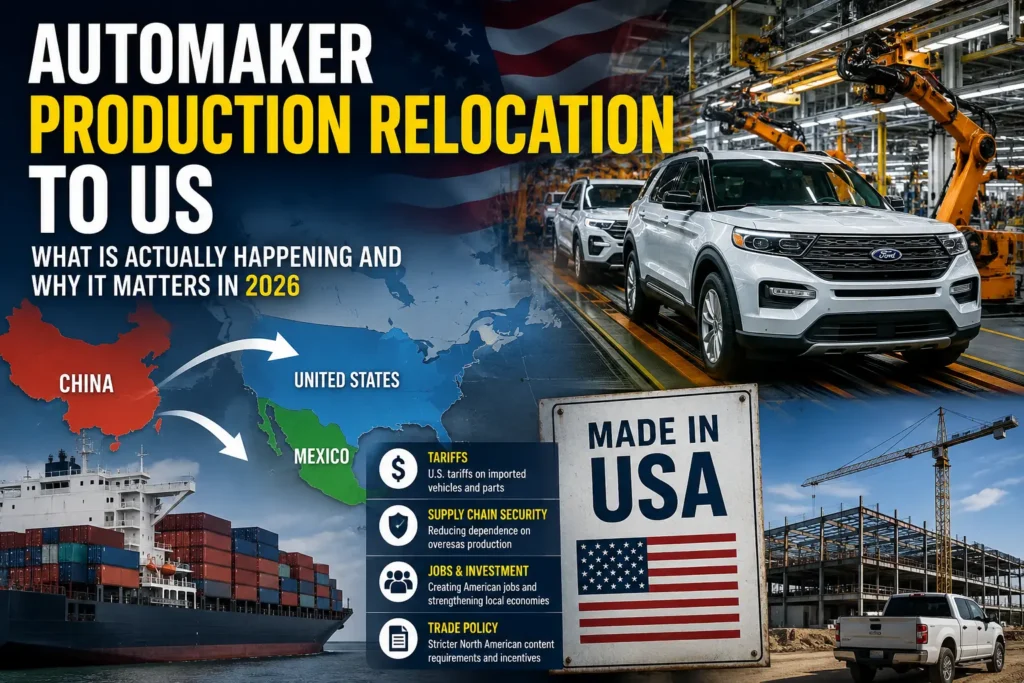
The story of automaker production relocation to US soil is one of the biggest industrial shifts of this decade. It is not just a business headline. It is a story about jobs, tariffs, supply chains, and the future of how cars are made in North America. Every week there is a new announcement, a new investment figure, a new plant breaking ground somewhere in the American heartland. If you have been following the news and wondering what is actually happening behind all the announcements, this article gives you the complete picture from every angle.
Why Automakers Are Moving Production to the United States
For decades, automakers built their supply chains around the idea that North America was essentially one unified market. Parts crossed the US, Mexico, and Canadian borders multiple times during the assembly process. Factories were placed wherever labor and land were cheapest. That system worked extremely well under trade agreements like USMCA, which allowed goods to flow freely across borders without heavy penalties.
Then the tariff pressure started and changed everything.
President Trump’s 25 percent tariffs on imported vehicles and auto parts changed the financial math almost overnight. Companies that were perfectly profitable building cars in Mexico suddenly found themselves paying a steep penalty on every single unit crossing the border into the US market. The pressure forced boardrooms to make decisions that would have seemed extreme just a few years earlier.
But here is the part that most news coverage misses entirely. This is not only about tariffs. The electric vehicle transition has also pushed automakers to rethink where their most strategically important vehicles get built. When your flagship EV or your highest-margin SUV is also your most politically visible product, building it on American soil becomes both a financial decision and a long-term brand decision at the same time.
The combination of tariff pressure and EV investment incentives from the Inflation Reduction Act created a situation where relocating production to the US was not just politically smart. For many companies it became the only move that made financial sense.
Which Automakers Are Actually Making the Move
General Motors
GM made the most concrete and detailed announcement so far. The company committed to a $4 billion investment over two years to shift production of two of its most popular and highest-selling models from Mexico to American plants.
The Chevrolet Blazer will move to the Spring Hill plant in Tennessee starting in 2027. The Chevrolet Equinox will be produced at the Fairfax Assembly plant in Kansas City, Kansas, also beginning in mid-2027. Sales of the redesigned Equinox were already up more than 30 percent year over year in the first quarter of 2025, which made the investment decision easier to justify internally.
GM’s Factory ZERO in Detroit will focus exclusively on electric vehicles going forward, including the Silverado EV, GMC Sierra EV, Cadillac Escalade IQ, and GMC Hummer EV. By early 2027 the Orion plant in Michigan will also restart operations, building gas-powered SUVs and pickups for the domestic market.
When all of this investment comes together, GM’s US production capacity will exceed two million vehicles annually. That is a significant structural shift for a company that had been steadily expanding its Mexican operations for the better part of two decades.
Honda and Stellantis
Both Honda and Stellantis have pledged to move meaningful portions of their production to America, though neither has announced timelines as specific as GM’s public commitments. Industry analysts have been clear and consistent that any real relocation takes a minimum of three years to execute properly from the decision point to the first vehicle rolling off the line.
You cannot simply pick up an assembly operation and move it across a border. You need land acquisition, zoning and environmental approvals, full infrastructure construction including power and water, equipment installation, supplier development within the new region, and an entire workforce hired and trained before a single finished vehicle can be produced.
The Battery Supply Chain Side
One of the most significant individual moves in this space came from LG Energy Solution, which relocated battery production for the Ford Mustang Mach-E from a facility in Poland all the way to Michigan. The reason was not purely about tariff avoidance. Moving domestic battery production made the Mach-E eligible for the full $7,500 federal EV tax credit, which made a direct and measurable difference to consumer pricing and purchase demand.
This pattern is playing out across the entire industry simultaneously. Production relocation is most often motivated by several overlapping incentives at the same time rather than a single policy driver. The companies moving fastest are the ones mapping all those incentives together and acting on the combined logic rather than waiting for perfect certainty on any one factor.
Why Politicians Make It Sound Easier Than It Is
Every time a politician says automakers simply need to move their factories back to America, industry veterans visibly wince. The gap between political rhetoric and industrial reality is genuinely enormous and worth understanding.
Building a new vehicle assembly plant is nothing like opening a new office or warehouse. A facility like Hyundai’s new plant in Georgia covers thousands of acres and includes millions of square feet of factory space. Getting from the moment a board approves the investment to the moment the first car rolls off the line requires a sequential process of site selection, land purchase, zoning changes, environmental impact reviews, construction, equipment installation, local supplier development, and the hiring and training of thousands of workers.
Industry analysts John Murphy and John Babcock summarized the economics plainly. Building out capacity and staffing a plant takes over three years at minimum. For most individual auto parts, relocating production to the US is not even economically viable when you run the actual numbers. In many cases paying the 25 percent tariff is cheaper than building new American manufacturing capacity for those specific components.
One unnamed senior auto executive described the situation with unusual honesty. If you have ever done a home renovation, you know that anything is possible if you put enough money behind it. But economically feasible is a completely separate question. Most US plants were already running near their full capacity coming out of the supply chain disruptions of the pandemic years, which adds yet another layer of complexity to the timeline.
The Role of Electric Vehicles in Accelerating This Shift
The robotaxi and electric vehicle transformation happening right now is not separate from the production relocation story. It is deeply connected to it.
The Inflation Reduction Act tied substantial EV tax credits directly to where vehicles and their battery components are manufactured. A car built outside the US with foreign-sourced battery materials does not qualify for those credits. A car assembled in the US with domestically sourced battery components can make a buyer eligible for up to $7,500 off the purchase price.
That financial incentive is enormous when you are trying to sell electric vehicles into a market that is still sensitive to the price premium EVs carry over comparable gas-powered alternatives. Automakers who get their US-based EV production running efficiently do not just avoid tariff costs. They gain a direct price advantage over competitors whose supply chains are still rooted offshore.
This is why the production relocation story and the EV story are impossible to separate in 2026. They are the same story told from two different angles.
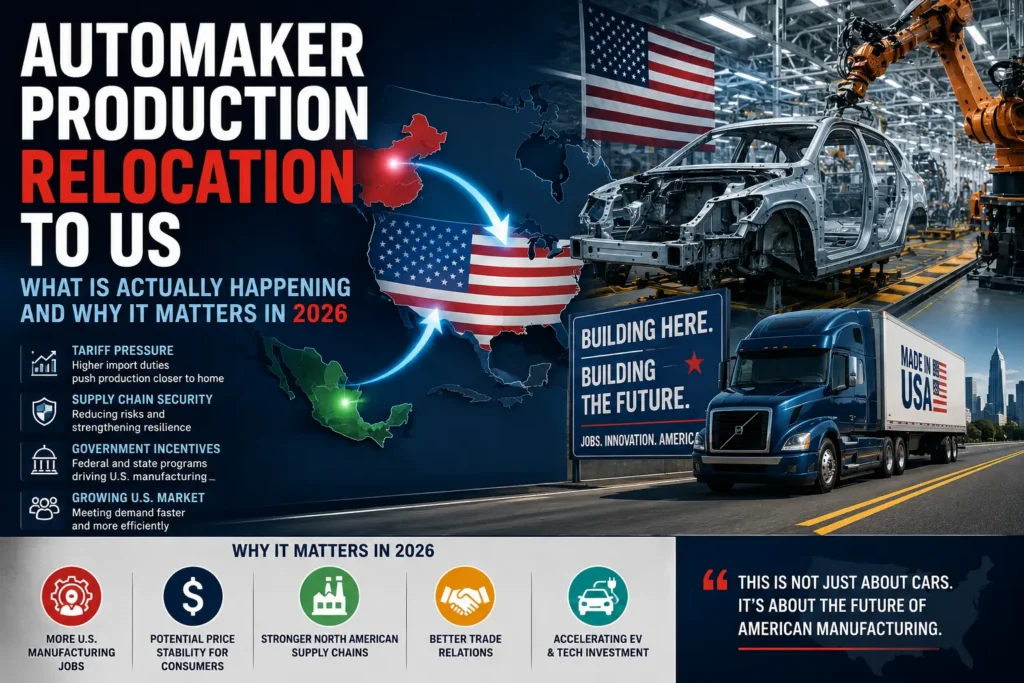
What This Means for American Jobs
The job creation element of this shift is real. It is just slower than the political narrative suggests and more complicated than a simple headline number conveys.
When GM adds production capacity in Tennessee and Kansas, those specific plants need skilled workers. But the employment impact extends far beyond the assembly floor. Tier one and tier two suppliers building components nearby also need workers. Local logistics and transportation companies serving the plant need workers. The broader regional economic activity generated by a large manufacturing facility creates employment across dozens of connected industries.
Over a multi-year period the employment impact of this production shift is genuinely significant and durable. These are not temporary construction jobs. They are long-term manufacturing roles that tend to anchor entire regional economies.
What It Means for Car Prices
The price question is more complicated and more honest answers are rare.
Cars built entirely in the US cost more to produce than cars assembled in lower-cost countries. Some of that cost differential gets absorbed by manufacturers accepting lower margins. Some of it gets passed directly to buyers through higher sticker prices. How much goes where depends on competitive dynamics, consumer demand, and how aggressively companies invest in automation and efficiency at their new American plants.
The EV dimension adds its own layer of complexity. Because electric vehicle production is still in relatively early stages of scaling, cost curves are moving fast and in the right direction. A company that invests now in US-based EV assembly could find itself operating a cost-competitive plant within three years even if the upfront capital investment is genuinely painful in the short term.
Buyers who are shopping for new vehicles in 2026 and beyond should expect some upward price pressure on models being shifted to US production. But they should also expect those same models to increasingly qualify for federal tax credits and state incentives that can offset a meaningful portion of that premium.
The Broader Reset of North American Manufacturing
What is happening right now is a structural reset of North American automotive manufacturing that has been building for years. It was accelerated by the pandemic supply chain crisis, pushed further by EV investment cycles, and then triggered into urgent action by tariff policy.
The companies moving fastest are the ones defining where the next generation of American car production actually happens. The ones waiting for full certainty on every policy variable may find the best plant locations, the most experienced local workforces, and the strongest regional supplier relationships already claimed by competitors who moved earlier.
This is also a story about which cities and states win the next chapter of American manufacturing. Tennessee, Michigan, Georgia, Kansas, and a growing list of other states are actively competing for these investments with land deals, tax incentives, and workforce training programs. The local economic impact of winning a major automotive assembly plant is transformational for a region and lasts for decades.
The automaker production relocation to US story is not finished. For most of the companies involved it is honestly just getting started. The announcements being made today will determine the shape of American manufacturing for the next twenty years.
For a deeper look at how technology is simultaneously reshaping what these vehicles actually do on the road, our full breakdown of what Waymo, Tesla, and Uber are doing with robotaxi technology in 2026 tells the other half of this story.
And if the remote work culture driving demand for home office upgrades interests you, this guide to riser desks on TechRush covers how workers setting up permanent home offices are thinking about their workspace as the nature of automotive industry jobs continues to evolve.