
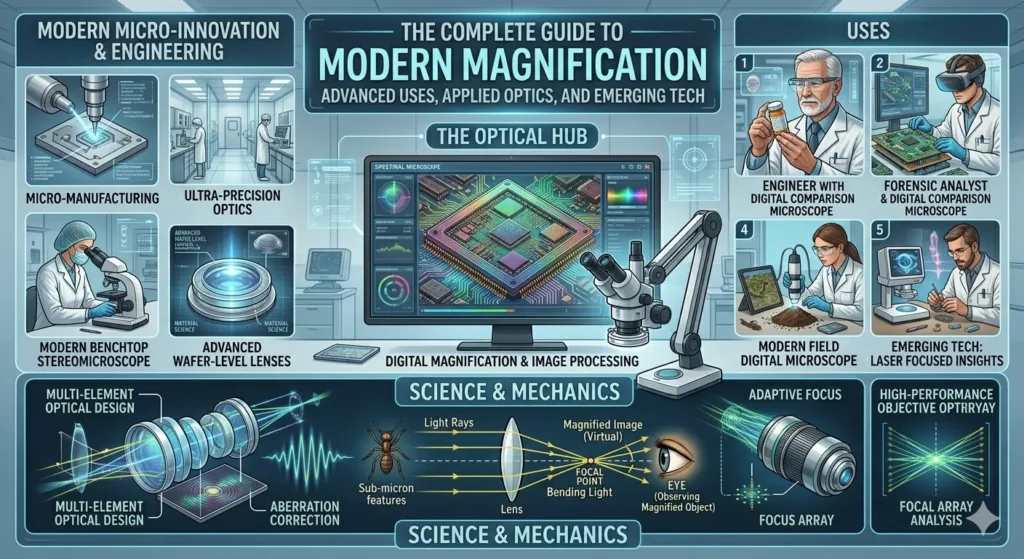
Pick up a magnifying glass and hold it over a coin, a leaf, a strand of hair, or a page of text, and something remarkable happens. Details that your naked eye simply cannot process suddenly become visible. Tiny scratches on metal surfaces. The cellular structure of a leaf’s edge. The individual fibers in a piece of cloth. The magnifying glass has been making the invisible visible for thousands of years, and it remains one of the most universally useful tools ever created.
Most people associate magnifying glasses with detectives, jewelers, or elderly relatives reading small print. But the actual range of applications stretches across medicine, science, education, art, law enforcement, hobbies, and everyday practical tasks in ways that genuinely surprise you when you start listing them out. This guide covers everything from the science behind how magnification works to the full breadth of what a magnifying glass is used for across different fields and activities.
What Is a Magnifying Glass?
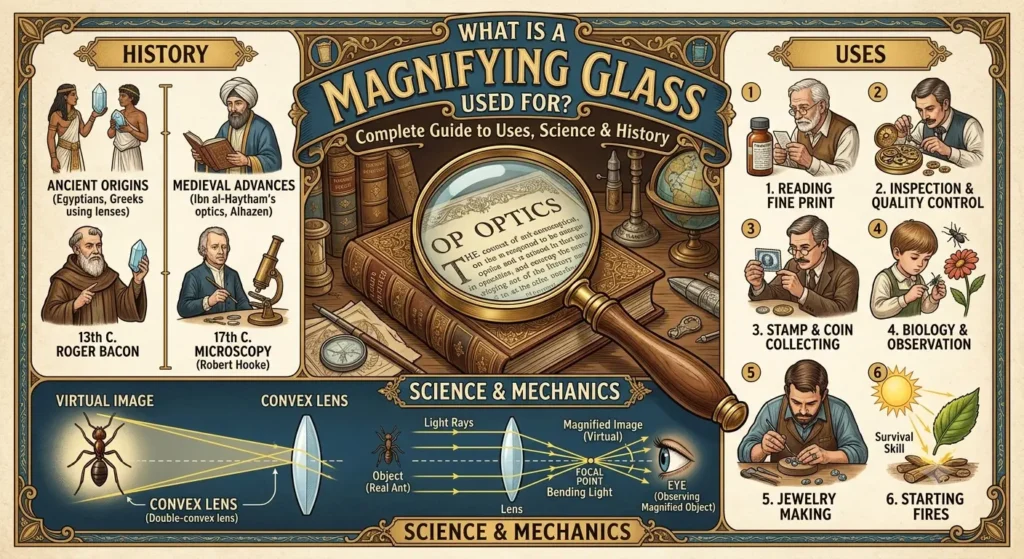
A magnifying glass is built around a single convex lens usually optical glass, though crystals and plastics are also used that converges light rays toward a focal point. Normally, light bounces off an object and travels to your eyes in parallel rays. The convex shape changes that.
A convex lens is thicker in the middle than at the edges, and that shape forces light rays passing through it to bend inward. When you hold the lens over an object, those bent rays reach your eye at a different angle than they normally would. Your brain reads that angle as evidence of a much larger object. That’s the enlarged image you see it’s a trick of perception, really, but an incredibly useful one.
There’s a sweet spot, though. Place the object within the lens’s focal length and you get a clear, enlarged, right-side-up image. Move too far back and the image flips and shrinks. Finding that zone is what makes practical magnification work.
Magnification is expressed with an x so a 2x lens doubles the apparent size, and a 10x loupe makes things look ten times bigger. Most handheld magnifying glasses sit somewhere between 2x and 5x, which covers the majority of everyday uses without the distortion that creeps in at higher powers.
A Brief History of the Magnifying Glass
To understand what a magnifying glass is used for today, it helps to know how long people have been reaching for ways to see things more clearly.
The story goes back further than most people expect. Around 750 BC, Assyrian craftsmen are believed to have used polished crystal as a magnifier, likely to help engrave fine detail into small objects. The Roman philosopher Seneca wrote about filling a glass globe with water to enlarge letters, and Emperor Nero reportedly watched gladiatorial contests through an emerald whether as a vision aid or pure spectacle, history doesn’t say for certain.
The major intellectual turning point came in 1021, when the scientist Ibn al-Haytham described how a convex lens magnifies objects in his Book of Optics. Once that work was translated into Latin in the 12th century, European scholars picked it up and ran with it.
The first magnifying glass built specifically for scientific purposes came from the English philosopher Roger Bacon in 1267. He was interested in optics and light refraction and made a practical tool to support that work. What followed was centuries of refinement that eventually gave us the microscope and the telescope two instruments that permanently changed what humanity knows about the world.
Scientific and Laboratory Uses
Specimen Examination
In a laboratory, the magnifying glass occupies a useful middle ground. It gives you more than your bare eyes can offer, without the setup and sample preparation a microscope requires. Biologists, zoologists, and geologists all reach for a handheld lens as a first look at specimens it’s quick, portable, and often enough to answer the immediate question.
Field researchers especially depend on this. If you’re doing work in a wetland or a forest, a microscope isn’t coming with you. A loupe in your pocket lets you examine leaf surfaces, seed structures, and insect features on the spot.
Botany and Nature Study
Botanists use magnifying glasses to examine plant structures, entomologists study insects up close, and geologists inspect the composition of rocks and minerals. A lot of what makes species identification possible comes down to small features the texture of a stem, the shape of a seed coat, the arrangement of hairs on a leaf that simply aren’t visible to the naked eye.
Laboratory Labeling and Equipment Inspection
There’s also the practical, unglamorous side of lab work: reading fine measurement markings, checking delicate equipment for wear or damage, and verifying small-scale setups. These aren’t glamorous uses, but they matter in environments where precision is everything.
Medical and Health Uses
The medical field has used magnification for as long as medicine has existed, and it still shows up in clinical practice in ways that directly affect patient care.
Dermatologists examining skin conditions depend on magnification to assess details color variation, border irregularity, surface texture that determine whether something is benign or worth investigating further. Wound healing, rash identification, and follow-up assessments all benefit from the additional clarity.
Dental loupes wearable magnifying lenses mounted on frames like glasses allow dentists to see the fine margins of crown preparations, detect hairline cracks in teeth, and work with the precision that modern dentistry demands. The placement of tiny implants and the detection of early decay both depend on this kind of close-up visibility.
Pharmacists checking pill markings, opticians assessing lens quality, and medical professionals reading small-print documentation all use magnification as a routine part of their work.
For people dealing with age-related vision loss or medical conditions affecting their sight, a magnifying glass is about more than convenience. Being able to read your own mail, check a medication label, or recognize a face without asking for help — that kind of independence matters in ways that are hard to overstate.
Professional and Trade Uses
Jewelry and Gemology
The standard tool for gemstone inspection is a 10x loupe, and at that magnification, the internal characteristics of a diamond become readable inclusions, clarity grades, facet quality. The difference between a high-quality stone and a flawed one, or between a genuine gem and a convincing imitation, is often only visible through that lens. It’s one of those tools that looks simple but takes real training to use well.
Watchmaking and Fine Mechanics
Traditional mechanical watches can contain over a hundred components, some so small they’re nearly invisible without help. Watchmakers use an eyepiece loupe to assemble, adjust, and repair at that scale. The same reasoning applies to electronics repair soldering tiny components, identifying trace damage on a circuit board, checking fine connectors all of it is easier when you can actually see the detail.
Forensic Investigation
Forensic examiners use magnification to study fingerprints, fiber evidence, tool marks, and document characteristics that aren’t visible at normal viewing distance. Document examiners looking for forged signatures or altered text look at the physical behavior of ink on paper pen pressure variations, paper fiber disturbance, printing inconsistencies things that only show up under magnification.
Everyday and Hobby Uses
Reading Small Print
This is probably what most people think of first, and it’s still genuinely relevant. Medication labels, financial documents, legal fine print, and food packaging regularly use type sizes that present real difficulty not just for older readers, but for anyone whose eyes aren’t perfect. A magnifying glass handles this without any charging or setup required.
Stamp and Coin Collecting
Collectors depend on magnification to assess condition and catch variations. For stamps, the quality of perforations, paper texture, and printing crispness all factor into value and can only be properly evaluated under a loupe. Coin collectors examine die marks, mint marks, and surface preservation in similar detail. Sometimes the difference between a common coin and a rare variety comes down to a small feature that’s easy to miss without magnification.
Needlework and Craft
Anyone who works with fine thread, embroidery, lace, or tiny model components quickly discovers what a magnifying glass adds to the experience. Threading a needle sounds trivial until your eyes struggle with it. Counting individual stitches, aligning small parts, and checking the quality of fine work all go more smoothly with a bit of magnification.
Reading Aged or Damaged Documents
Historians, genealogists, and archivists working with old manuscripts and faded letters face a real challenge. Ink fades, paper deteriorates, and water damage can make text that was once perfectly legible nearly unreadable. Magnification often recovers enough detail to decipher what time has worn down which can matter a great deal when you’re tracing a family history or reading a primary source.
Educational Uses
Magnifying glasses play a vital role in education, especially in science. Students use them to observe biological specimens, explore the texture of materials, and conduct experiments.
There’s something that happens when a child looks at a familiar object through a magnifying glass for the first time and sees it transformed the tiny hairs on a caterpillar, the grain structure of a piece of wood, the facets on a grain of salt. No textbook image really replicates that direct sensory surprise. It’s one of the most effective ways to build genuine curiosity about the natural world, and it costs almost nothing.
At higher levels, more powerful tools take over, but the handheld magnifying glass remains a useful introductory and field instrument throughout a student’s education.
How to Choose the Right Magnifying Glass
The right magnifying glass depends entirely on what you’re using it for. Here’s a practical breakdown:
| Use Case | Recommended Magnification | Features to Look For |
| General reading | 2x to 3x | Large lens, comfortable handle |
| Coin and stamp collecting | 5x to 10x | Optical quality glass, minimal distortion |
| Jewelry inspection | 10x loupe | Achromatic lens, portable design |
| Laboratory use | 5x to 10x | Stand-mounted option, LED illumination |
| Watchmaking | 10x loupe | Hands-free design |
| Vision assistance | 3x to 5x | Large lens, bright LED light, ergonomic handle |
| Children and education | 3x to 5x | Durable construction, lightweight |
| Document examination | 5x to 8x | Flat field lens for edge-to-edge clarity |
The quality of the lens matters as much as the magnification number. Cheap plastic lenses distort the edges, introduce color fringing, and make extended use uncomfortable. For anything more than occasional use, optical glass makes a real difference.
Illuminated magnifying glasses solve a common problem when you hold a lens close to a surface, it casts a shadow that can actually make fine detail harder to see. Built-in LED lighting eliminates that issue and makes a noticeable difference in practice.
Frequently Asked Questions
What is the primary use of a magnifying glass?
Making objects appear larger than they are so you can see detail that isn’t visible to the naked eye. The range of situations where that matters turns out to be surprisingly wide from medical diagnosis to hobbyist crafts.
What are the most common professional uses?
Jewelry inspection and gemology, dental and medical examination, forensic document analysis, watchmaking and fine mechanics, stamp and coin assessment, and scientific specimen examination in laboratory and field settings.
How does a magnifying glass work?
A convex lens bends incoming light rays toward a focal point. When an object sits within that focal length, your eye reads the bent rays as coming from a larger object. The extent of the enlargement depends on the curvature and thickness of the lens.
What magnification is best for reading?
For most reading tasks, 2x to 4x is comfortable without significant distortion. Higher magnifications narrow the field of view you end up seeing a smaller patch of text and have to move the lens more often, which gets tiring quickly.
Can a magnifying glass start a fire?
Yes. Focused in direct sunlight, a magnifying glass concentrates solar energy onto a point with enough intensity to ignite paper, dry leaves, or tinder. This has been known since ancient times and is the principle behind burning glass demonstrations. Don’t leave one sitting in a sunny window near anything flammable.
Who invented the magnifying glass?
Roger Bacon built the first magnifier made specifically for scientific use in 1267, focused on his study of optics and light refraction. But people had been using natural crystals and shaped glass to enlarge objects for thousands of years before that it was more of a gradual development than a single invention.
Final Thoughts
The magnifying glass is one of those tools that reveals how much of the world sits just beyond what our eyes can resolve on their own. We handle objects, read documents, and walk past surfaces every day without seeing the level of detail that’s always been there.
From the ancient Assyrian craftsmen who used polished crystals to the modern dental surgeon examining the margins of a crown, the core principle hasn’t changed in three thousand years: bend the light, and see more clearly. It’s not a complicated idea. But it turns out to be a genuinely profound one.
Whether you’re a collector, a student, a clinician, or someone who just needs to read the fine print on a medication bottle without squinting the magnifying glass has earned its place in pockets, toolboxes, laboratories, and workshops across centuries of human use. Its continued relevance says something worth noting about how fundamental the need to see things clearly really is.