
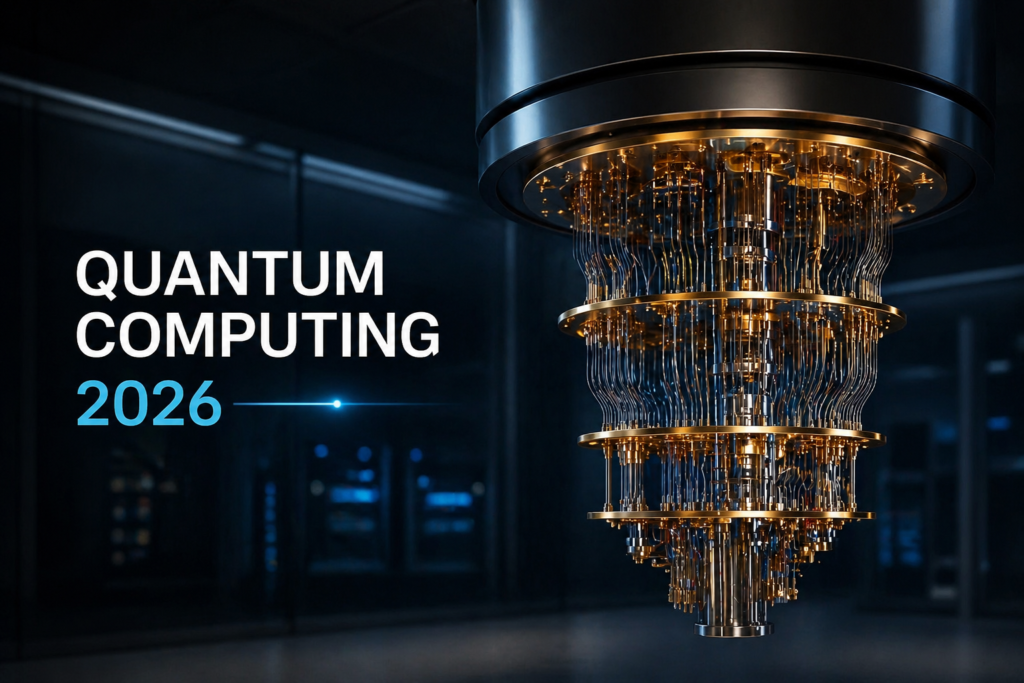
Most people have heard the phrase quantum computing so many times it has started to blend into the background. Tech companies have been promising a quantum revolution for over a decade. Every year brings announcements about breakthroughs that never quite seem to change anything ordinary people can actually use. You would be forgiven for tuning it out.
Something shifted in 2026 though. Not because the promises got bigger. Because the science got more specific and more verifiable. The announcements coming out of research labs and technology companies this year are not about what quantum computers might eventually do. They are about what quantum computers are doing right now, in real facilities, on real problems, with results that peer-reviewed journals are publishing and that serious investors are backing with real money.
This is what those advances actually look like.
What Quantum Computing Actually Is
Before getting into what is happening this year, it helps to be clear about what quantum computing is and why it matters. The concept gets explained badly more often than it gets explained well, so here is the plain version.
A regular computer processes information using bits. A bit is either a 1 or a 0. Every calculation your computer does, every email it sends, every video it plays, comes down to enormous numbers of 1s and 0s being flipped and processed at high speed.
A quantum computer uses qubits instead of bits. A qubit can be a 1, a 0, or both at the same time, a property called superposition. On top of that, qubits can be entangled, meaning the state of one qubit can instantly affect another no matter how far apart they are. These two properties together let quantum computers explore enormous numbers of possible solutions to a problem at the same time rather than checking them one by one.
The practical consequence is that certain types of problems which would take a classical computer millions of years to solve could be solved by a sufficiently powerful quantum computer in hours or minutes. Drug discovery. Materials science. Financial modeling. Cryptography. Climate simulation. These are not distant theoretical ideas. They are exactly the problems quantum computing research is targeting right now.
The complication is that qubits are extraordinarily fragile. The smallest vibration, temperature change, or electromagnetic interference can cause a qubit to lose its quantum state, a problem called decoherence. Building a quantum computer that is both powerful and reliable enough to outperform classical computers on real problems has been the central challenge of the field for two decades. In 2026, that challenge is not solved. But the people working on it are closer than they have ever been, and some of their recent results are genuinely worth paying attention to.
The Biggest Developments of 2026 So Far
Several things happened in the first four months of 2026 that stand out as more than just well-marketed announcements.
Researchers from QuEra Computing, Harvard University, and MIT published results in April 2026 demonstrating a 2 to 1 physical-to-logical qubit ratio using reconfigurable neutral-atom hardware. This matters because error correction, which we will get to shortly, requires using multiple physical qubits to represent a single reliable logical qubit. Getting that ratio down to 2 to 1 is dramatically more efficient than what previous approaches achieved. Their simulations showed error rates in what researchers call the Teraquop regime, which suggests that fault-tolerant quantum computing may need less hardware than the field previously estimated.
Microsoft, working with the startup Atom Computing, committed to delivering an error-corrected quantum computer to the Export and Investment Fund of Denmark and the Novo Nordisk Foundation. This is a commercial delivery, not a research demonstration. The company’s vice president of quantum described 2026 as the year when work from the last several years is finally coming to fruition. Whether that framing holds up will be clearer once those machines are actually running on real problems.
A study from University College London published in April 2026 showed that combining quantum computing with artificial intelligence dramatically improves predictions of complex physical systems over long periods of time. The quantum-informed AI model outperformed leading classical AI models while using significantly less memory. Professor Peter Coveney, senior author of the study, described applications in climate forecasting, blood flow modeling, molecular interaction, and wind farm design. The results were published in Science Advances, which is not a low-bar journal.
Pennsylvania launched the Keystone AI and Quantum Factory in April 2026, a statewide initiative uniting the state’s top research universities to translate quantum research into industrial applications. It covers workforce development, shared infrastructure, and advanced computing resources across energy, manufacturing, and life sciences. The significance is not the initiative itself but what it signals: quantum computing is now being treated as regional economic infrastructure by state governments, not just a curiosity for academic labs.
IonQ and Q-CTRL announced the integration of Q-CTRL’s Fire Opal software into the IonQ Quantum Cloud. The integration automates error suppression and problem mapping in ways that let users run optimization algorithms without needing deep quantum expertise. The practical effect is that the barrier to using quantum computing for real optimization work has come down.
Why Error Correction Keeps Coming Up
If you follow quantum computing news for any length of time, you keep running into the same phrase: error correction. Understanding why it matters explains most of what is happening in 2026.
Quantum computers are not useful if their qubits keep making mistakes. The fragility of qubits means errors are constantly introduced into calculations. Early quantum computers had error rates high enough that their results were essentially unreliable for anything serious. Researchers have known for years that the path forward runs through error correction: encoding quantum information in ways that let you detect and fix errors without destroying the computation you are running.
The problem is that early error correction approaches required hundreds or even thousands of physical qubits to represent a single reliable logical qubit. That made scaling up prohibitively expensive in hardware terms.
The Harvard, MIT and QuEra result is significant because it gets that ratio down to 2 to 1. If the approach scales as hoped, the road to a practically useful fault-tolerant quantum computer is shorter than the field previously thought.
Microsoft is pursuing a completely different path, working on what it calls topological qubits based on Majorana zero modes, particles that store quantum information in a way that is inherently more resistant to noise. Results from earlier in 2026 confirmed the protected nature of Majorana qubits and showed millisecond-scale coherence times. IBM has taken a third approach, focusing on making near-term applications work on today’s imperfect hardware rather than waiting for perfect error correction to arrive.
Three different technical bets, all being pursued simultaneously by well-funded teams. The field has not converged on a single answer, which is not a bad sign. Most major technology transitions have worked exactly this way: multiple competing approaches run in parallel until one proves out at scale and the others either follow or fade.
What Quantum Computers Are Actually Doing Right Now
The question most people want answered is not how quantum computing works. It is what it is being used for today.
Drug discovery draws the most serious investment right now. Pharmaceutical companies spend billions of dollars and many years testing molecular compounds to find ones that might become effective medicines. Quantum computers can simulate molecular interactions at a level of precision that classical computers genuinely cannot match. Equal1 and Kvantify announced a partnership in April 2026 specifically targeting quantum-enhanced drug discovery and biotechnology. The potential to shorten drug development timelines by years, and to find effective compounds for diseases that have resisted classical simulation, makes this the application with the most immediate commercial pressure behind it.
Financial modeling is another area where quantum approaches are being actively tested. Portfolio optimization, risk analysis, and fraud detection all involve searching through enormous numbers of possible combinations to find optimal outcomes. Classical computers approximate these problems. Quantum computers, in principle, can solve them exactly. Several major financial institutions now have active quantum computing research programs that have moved past exploratory phases.
Cryptography is the application that generates the most public concern, and the concern is legitimate. Much of the encryption protecting banking, government communications, and personal data online is based on mathematical problems that classical computers cannot solve in any practical timeframe. A sufficiently powerful quantum computer could break those systems. Experts estimate that quantum computers capable of this may emerge as early as 2029, which has pushed enormous investment into post-quantum cryptography, building new encryption standards designed to hold up even against quantum attacks.
Climate modeling benefits from the same underlying property that makes quantum useful for drug discovery. Complex physical systems with enormous numbers of interacting variables are exactly the category of problem where quantum approaches can outperform classical ones. The UCL study from April 2026 showed quantum-informed AI models performing significantly better than classical approaches on the fluid dynamics problems that sit at the heart of climate prediction.
The Parts the Industry Does Not Talk About Enough
Quantum computing attracts enormous investment, which creates pressure to overstate progress. A team of physicists published results in early 2026, after two years of peer review, showing that several earlier quantum computing breakthroughs that had been widely celebrated could actually be explained by simpler classical mechanisms.
The paper was led by University of Pittsburgh professor Sergey Frolov along with collaborators from Minnesota and Grenoble. They carried out replication studies focused on topological effects in nanoscale devices and found that signals hailed as major advances could be explained in other ways when more complete datasets were analyzed. The paper called for more data sharing and open discussion of alternative interpretations. It took two years to get published because the scientific community needed extensive debate before accepting that earlier interpretations might be incomplete.
This pattern matters for anyone trying to understand where quantum computing actually stands. The genuine progress is real. The pressure to hype it is also real. The honest picture in 2026 is that quantum computing is past early proof-of-concept work but has not yet delivered the transformative commercial applications its most enthusiastic advocates predicted. Error correction is advancing. Hardware is becoming more reliable. Specific applications in drug discovery, optimization, and AI are producing verifiable results. The timeline to broadly useful fault-tolerant quantum computers sits somewhere between five and fifteen years, depending on which technical challenges prove hardest to crack.
What has shifted in 2026 is that the field has moved from debating whether quantum computing will work to debating how quickly specific versions of it will become commercially viable. The question changed. That matters.
What to Watch for the Rest of 2026
The IEEE Quantum Week conference takes place in Toronto from September 13 to 18, 2026. Organizers describe it as the premier event for quantum professionals and researchers, featuring more than 600 hours of content. It will be the most comprehensive public look at the current state of quantum technology available in one place this year.
Microsoft’s delivery of error-corrected quantum machines to customers in Denmark will be closely watched as the first real-world test of whether error-corrected systems can establish scientific advantage on practical problems. If the results hold up, they will accelerate competition across the industry.
The post-quantum cryptography timeline is also moving. The National Institute of Standards and Technology has been working on standardizing post-quantum encryption algorithms, and 2026 is expected to see those standards finalized. Organizations will then face the significant work of updating encryption infrastructure that has been in place for decades.
Quantum sensing, which uses quantum systems to make extremely precise measurements, is expected to deliver commercial value for the first time in 2026. Applications in biomedical imaging and automotive sensing have been identified as early markets with realistic near-term deployment potential.
Frequently Asked Questions
What is quantum computing in simple terms?
Quantum computing uses the principles of quantum physics to process information in ways that classical computers cannot. Instead of bits that are either 1 or 0, quantum computers use qubits that can be both simultaneously. This lets them solve certain types of complex problems far faster than any classical computer could manage.
How close are we to practical quantum computers?
Closer than a year ago, though still not there for most real-world applications. Error correction is progressing meaningfully in 2026, with the Harvard, MIT and QuEra team achieving a 2 to 1 physical-to-logical qubit ratio. Microsoft is delivering error-corrected machines to paying customers. Most experts put broadly useful fault-tolerant quantum computers somewhere between five and fifteen years out, depending on which technical challenges prove hardest to solve.
What problems can quantum computers solve that regular computers cannot?
The clearest near-term applications are molecular simulation in drug discovery, optimization problems in finance and logistics, and certain AI acceleration tasks. Breaking current encryption is theoretically possible but requires a scale of quantum computer that does not exist yet.
Is quantum computing a threat to internet security?
It will be, eventually. Quantum computers powerful enough to break current encryption could arrive as early as 2029 according to some expert estimates. Governments and technology companies are investing heavily in post-quantum cryptography to get ahead of that. The transition to quantum-resistant encryption is one of the more significant infrastructure challenges of the coming decade.
Which companies are leading in quantum computing?
The main players are IBM, Google, Microsoft, IonQ, Quantinuum, and QuEra, alongside a growing number of well-funded startups. China is making significant national investment in quantum technology as well. Each company is pursuing different technical approaches, and it is genuinely unclear which will prove most viable at commercial scale.
Will quantum computers replace regular computers?
No. Quantum computers are not better than classical computers at most things. They are dramatically better at specific categories of problems, particularly those involving enormous numbers of variables or combinations. The most likely future involves hybrid systems where quantum and classical computers work together, each handling the work it is best suited for.
Where Things Actually Stand
Quantum computing advances in 2026 are real and specific in ways that the field’s long history of hype has often obscured. Error correction is moving forward. Commercial deliveries are happening. Real applications in drug discovery, AI, and optimization are producing results that peer-reviewed science is confirming rather than just press releases claiming.
The technology is not living up to its most ambitious predictions. It is living up to the more modest ones consistently enough that serious scientific and investment communities have moved on from asking whether it works to asking when particular versions of it will scale.
Those are different questions. The second one has a more encouraging set of answers. Whether those answers hold up through the rest of 2026 and beyond is what the next few years of development will actually tell us.